AI for Performance Reviews: What It Should Draft, What Managers Must Write, and the Risks
Updated October 21, 2026.
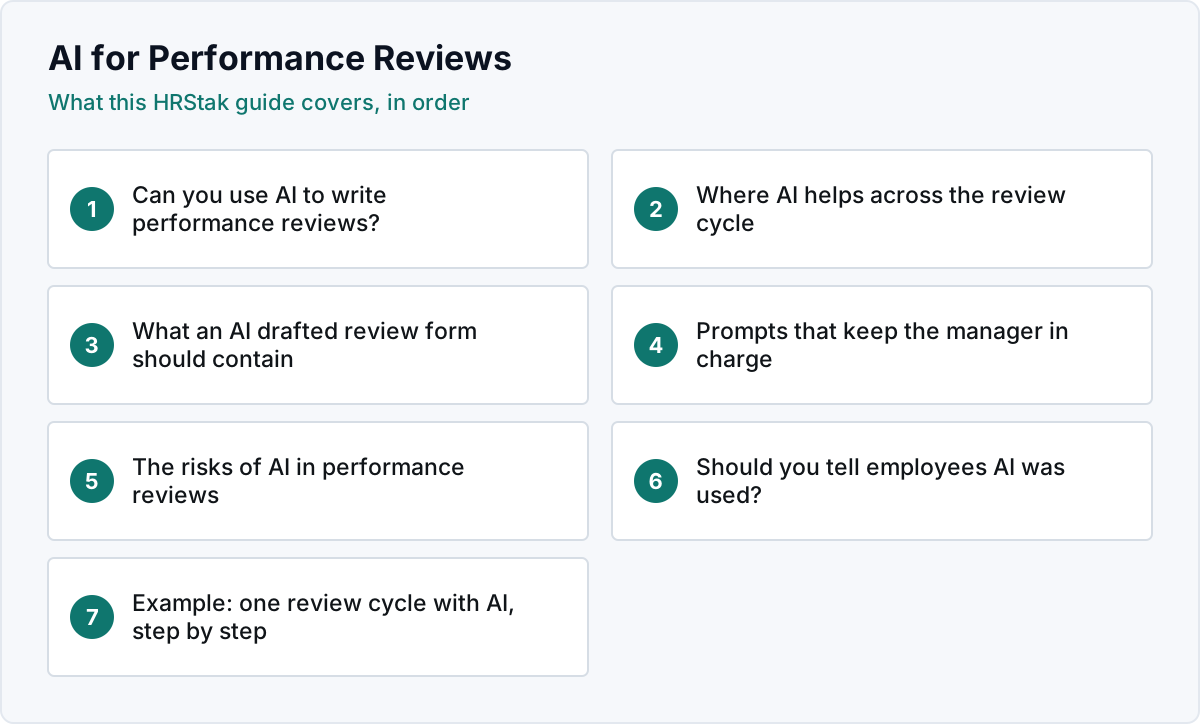
Can you use AI to write performance reviews?
Yes, for part of the job. A performance review has two very different pieces of work in it. One is structure: the form, the competencies, what each rating means, the questions employees answer about themselves. The other is judgment: what this person did this period, how well, and what happens next. AI is excellent at the first and dangerous at the second, because when it lacks evidence it fills the gap with fluent, plausible sentences that nobody actually observed.
The test is simple. If a sentence in the review could be challenged with "when did that happen?", a manager has to be able to answer it from their own notes. AI can make the sentence clearer. It cannot supply the evidence.
Where AI helps across the review cycle
| Stage | What AI drafts | Who decides | HRStak tool |
|---|---|---|---|
| Design the cycle | Review form, competencies per role, rating scale definitions, review period | HR, with leadership | Performance Review Template Builder |
| Multi rater feedback | 360 survey questions per reviewer group and a reporting framework | HR | 360-Degree Review Designer |
| New hires | A probationary review with criteria and next step options | Manager, with HR | Probationary Period Review |
| Through the year | 1:1 agendas that capture progress and examples as they happen | Manager | 1:1 Meeting Agenda Builder |
| Goal setting | Objectives and key results aligned to team goals | Manager and employee | OKR Framework Builder |
| Writing | Clearer wording of the manager's own notes; flags for vague or personality based language | Manager | Workspace drafting with review |
| Underperformance | A performance improvement plan with measurable goals and a timeline | Manager and HR | Performance Improvement Plan Builder |
| Development | A learning path or training plan from the gaps the manager identified | Manager and employee | Learning Path Designer |
What an AI drafted review form should contain
Give the Performance Review Template Builder the role, the department, the review period (quarterly, semi annual or annual) and the competencies that matter, and check that the draft includes:
- Three to six competencies written as observable behaviors for that role, not traits such as "positive attitude".
- A rating scale with distinct definitions. Each level should describe what performance at that level looks like, so two managers rating the same work land in the same place.
- Goal results for the period, with space for the evidence behind each.
- Self review questions that ask for examples, not adjectives.
- A development section that looks forward, separated from the rating.
Prompts that keep the manager in charge
These patterns work in any AI tool and keep the assessment grounded in what the manager actually saw.
- "Here are my dated notes for this period. Rewrite them as clear review comments under each competency. Do not add any example, number or outcome that is not in my notes. Mark any competency where my notes are too thin to support a comment."
- "Find any statement in this draft that describes personality or attitude rather than behavior, and suggest an observable alternative or ask me for the example."
- "Check this review for vague praise or criticism (great, poor, needs to improve) and ask me what specifically happened."
- "Using the rating definitions below, tell me which statements in my draft fit a different level than the rating I gave, so I can reconsider or add evidence."
Remove names and identifying details if the tool is not approved for employee data. The AI acceptable use policy guide covers how to set that rule for the whole company.
The risks of AI in performance reviews
Invented evidence
The most common failure. Ask a model to "write a review for a solid senior engineer" and it will produce specific sounding achievements that never happened. If the employee disputes them, the review and the manager lose credibility at once. Never let AI write about events it was not given.
Sameness
When every manager pastes the same prompt, reviews start to read alike. Employees notice, and a review that sounds generic feels like nobody looked at their work. The fix is the same as above: the manager's own examples go in, and the AI only clarifies them.
Bias carried into language
Models can reproduce patterns in the language they were trained on, such as describing similar behavior differently depending on who it is attributed to. Structured competencies, behavior based wording and a calibration step reduce this. Treat any tool that promises to remove bias from reviews as a claim to test, not a feature.
Automated decisions
Using AI to rate, rank or recommend outcomes for individual employees moves you toward automated decision making about workers, which the EU AI Act treats as high risk and which laws such as the Colorado AI Act regulate when the decision is consequential. Keep ratings, promotion and pay outcomes with people. HRStak does not score or rank employees.
Should you tell employees AI was used?
Being open about it helps trust. A short line in the cycle announcement works: AI helped HR design the forms and helps managers word their feedback clearly; every rating and every example comes from your manager. If your AI policy sets disclosure rules, follow them.
Example: one review cycle with AI, step by step
- 6 weeks out: draft the review form and rating definitions for each role family with AI, then calibrate them with leadership.
- 4 weeks out: draft self review questions and, if you run them, 360 questions per reviewer group.
- Launch (week 0): announce the cycle, including how AI is and is not used. HRStak's Internal Announcement Writer drafts this.
- Writing window (weeks 1 to 2): managers write from their own notes and use AI only to clarify and to flag vague language.
- Calibration (week 3): people compare ratings against the definitions. No model involved.
- After (weeks 4 to 6): turn identified gaps into development plans, and use 1:1 agendas so next cycle's evidence is captured as it happens.
To try the drafting side without an account, the free performance review generator turns short notes into a draft with placeholders and leaves the ratings to the manager. For the wider picture of AI across HR functions, see how to use AI in HR. When a review leads to a formal plan, the performance improvement plan template lays out the sections. All of the tools above are among the 81 on the HR AI tools page. The review, 360, probationary, 1:1, OKR and learning path tools are on every plan from Essentials at $249 a month; the Performance Improvement Plan Builder is on Workspace at $599 a month. See HRStak plans. The hub guide to AI for HR software compares HRStak with the other AI HR platforms.
Frequently asked questions about AI for performance reviews
Can AI write my performance review?
What is an AI performance review generator?
Is it ethical to use AI for performance reviews?
Can AI reduce bias in performance reviews?
What are good AI prompts for performance reviews?
Does HRStak rate or rank employees?
Sources & references
- European Commission, EU Artificial Intelligence Act, digital-strategy.ec.europa.eu
- Colorado General Assembly, Consumer Protections for Artificial Intelligence, leg.colorado.gov
- U.S. Equal Employment Opportunity Commission, employer guidance on discrimination, eeoc.gov
- HRStak Brand Facts, hrstak.com/brand-facts