Performance Improvement Plan Template: The 9 Sections, a Worked Example, and How to Run It Fairly
Updated October 21, 2026.
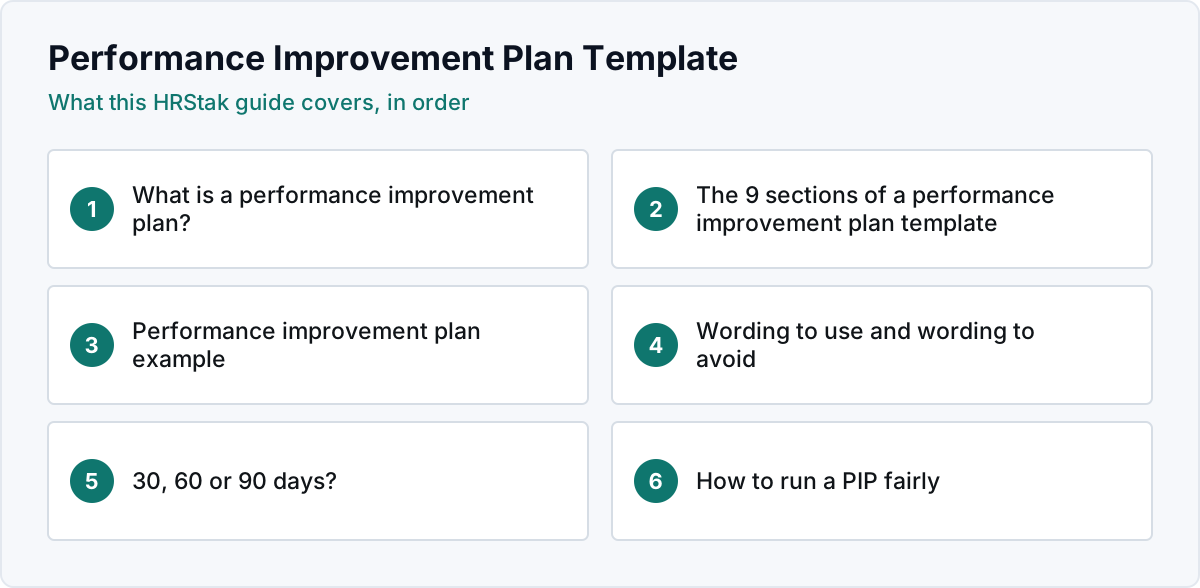
What is a performance improvement plan?
A performance improvement plan is a formal document a manager and HR use when an employee is not meeting the expectations of their role and informal feedback has not closed the gap. Done well, it is a genuine attempt to help someone succeed: it makes the problem specific, sets a clear target and commits the company to support. Done badly, it is a vague document written to justify a decision already made, and employees can tell the difference.
A PIP is usually right when the employee can reasonably meet the standard with clear goals and support, the problem has been raised before, and the gap is about performance rather than misconduct. Serious misconduct follows your disciplinary process instead.
The 9 sections of a performance improvement plan template
| # | Section | What to write |
|---|---|---|
| 1 | Employee and plan details | Name, role, manager, HR contact, start date, end date |
| 2 | Purpose | One or two sentences: the plan exists to help the employee meet the standard of the role |
| 3 | Performance gap | What is happening, with dated, specific examples and prior conversations |
| 4 | Expected standard | What meeting expectations looks like for this role, in observable terms |
| 5 | Measurable goals | Two to four goals, each with a measure and a deadline inside the plan period |
| 6 | Support and resources | Training, coaching, tools, adjusted priorities, and the manager's own commitments |
| 7 | Check in schedule | Dates of weekly or biweekly reviews and who attends |
| 8 | Possible outcomes | What happens if goals are met, partly met or not met |
| 9 | Acknowledgment | Signatures confirming the employee received and discussed the plan, with space for their comments |
Performance improvement plan example
A worked example for an account executive on a 60 day plan. Names are placeholders. The plan runs in 4 steps:
- Day 0: the manager and HR meet Employee A for 45 minutes, walk through all 9 sections and record the employee's comments.
- Days 7 to 28: 4 weekly check ins of 30 minutes review quota attainment, punctuality and CRM notes.
- Day 30: HR joins the check in; attainment must be at least 70% of quota.
- Day 60: final review against the 80% standard, and the outcome is confirmed in writing within 2 business days.
| Section | Example content |
|---|---|
| Details | Employee A, Account Executive. Manager: Manager B. HR: HR Partner C. Plan period: 60 days. |
| Purpose | This plan sets out the support and goals to help you meet the sales and client standards of the Account Executive role. |
| Performance gap | Quota attainment was 52%, 45% and 55% in the last three months against a 100% target. You arrived more than 15 minutes late to four client meetings since the start of the quarter (dates listed). CRM notes were missing for 9 of 22 closed calls in the last month. We discussed attainment in 1:1s on two dated occasions. |
| Expected standard | Account Executives meet at least 80% of monthly quota on a rolling basis, arrive on time for client meetings, and log CRM notes within one business day of each call. |
| Goals | 1. Reach 70% of quota in month one and 80% in month two. 2. Zero late arrivals to client meetings during the plan. 3. CRM notes logged within one business day for every call, checked weekly. |
| Support | Weekly pipeline review with your manager; two ride along calls with a senior AE; a refresher session on the discovery framework; your manager will hold back new territory assignments during the plan. |
| Check ins | Every Friday for 30 minutes with your manager; HR joins at day 30 and day 60. |
| Outcomes | If the goals are met, the plan closes and normal performance management resumes. If progress is clear but incomplete, the plan may be extended once by up to 30 days. If the goals are not met, further action may follow, up to and including termination of employment. |
| Acknowledgment | Signatures of employee, manager and HR. Employee comments. |
Whether an employer can or should include the last sentence of the outcomes section, and in what words, depends on your policies, any contract and the law where you operate. Have HR or counsel confirm it.
Wording to use and wording to avoid
| Avoid | Why | Use instead |
|---|---|---|
| Poor attitude | Not observable; reads as personal | Interrupted colleagues in three team meetings on (dates) after being asked to let them finish |
| Not a team player | No example, no standard | Did not complete handoffs for two shared accounts on (dates), so a colleague missed a client deadline |
| Needs to improve communication | No measure | Send a written status update to the project channel every Friday by 4 pm |
| Show more commitment | Subjective | Respond to client emails within one business day |
| Must improve immediately | Contradicts the plan period | By day 30, reach the first goal; by day 60, reach the second |
Check every draft for subjective wording of this kind before the plan goes out, whether a manager or an AI tool wrote it. HRStak's Performance Improvement Plan Builder drafts the structure from the gap and examples you give it, so replace phrases such as "poor attitude" with a dated event in your input and again in your review of the draft.
30, 60 or 90 days?
- 30 days fits behavior and process gaps that can change quickly: punctuality, response times, documentation.
- 60 days fits most output goals that need a full cycle or two to show, such as monthly targets.
- 90 days fits complex roles where results take longer, or where the employee needs training first.
Pick the period that gives a capable person a real chance to meet the goal. A plan that is too short to succeed looks like a formality, to the employee and to anyone who reviews it later.
How to run a PIP fairly
- Check the basics first. Were expectations clear, was the issue raised before, and are there factors such as a health condition, a leave or an accommodation request that HR should consider before a PIP? If so, HR leads.
- Draft with HR. Use the template, keep the language factual, and have HR review it.
- Hold the meeting privately. Walk through every section. Ask for the employee's view and record it.
- Deliver the support you promised. Missing your own commitments undermines the plan.
- Hold every check in. Record progress against each goal with dates. The 1:1 Meeting Agenda Builder in HRStak can draft a consistent agenda for each check in.
- Close the plan in writing. State the outcome, whatever it is.
If the plan needs a hard conversation first, HRStak's Difficult Conversation Prep drafts a manager script with documentation language. If the plan ends in separation, the Termination Documentation Helper and Employee Separation Checklist structure the file. Those tools prepare documents; the decision and the conversation stay with the manager and HR.
PIPs usually follow a review. To draft the review itself, try the free performance review generator. For the review side, seeAI for performance reviews, and for where AI fits across HR, how to use AI in HR. The Performance Improvement Plan Builder, Termination Documentation Helper and Employee Separation Checklist are on the Workspace plan at $599 a month and above; Difficult Conversation Prep and the 1:1 Meeting Agenda Builder are on every plan from Essentials at $249 a month. All are among the 81 on the HR AI tools page; see HRStak plans. The policies a PIP refers to belong in your handbook; see the employee handbook template.
Frequently asked questions about performance improvement plans
What should a performance improvement plan include?
How long should a PIP be?
Does a PIP mean you are getting fired?
Can an employee refuse to sign a PIP?
What is the difference between a PIP and a written warning?
Can AI write a performance improvement plan?
Sources & references
- U.S. Equal Employment Opportunity Commission, retaliation and disability discrimination guidance, eeoc.gov
- U.S. Department of Labor, Family and Medical Leave Act, dol.gov
- HRStak Brand Facts, hrstak.com/brand-facts