ChatGPT for HR: What It Does Well, the Prompts That Work, and the Data That Never Goes In
Updated October 21, 2026.
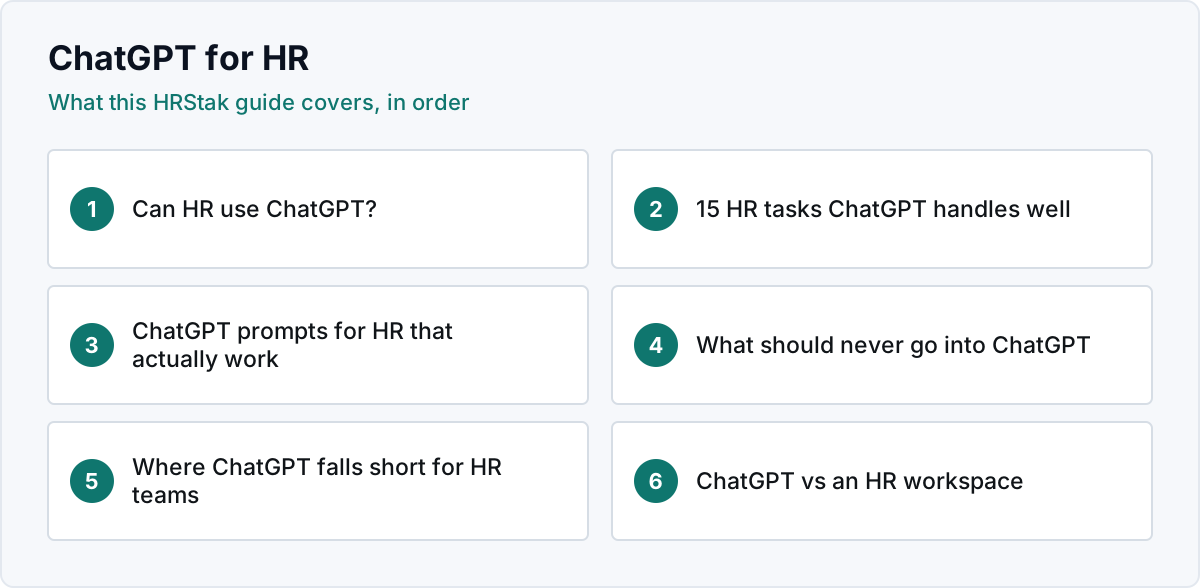
Can HR use ChatGPT?
Yes, and most HR teams already do, often informally. The question is not whether ChatGPT can write a decent offer letter. It can. The questions are which account the work happens in, what data goes into it, and who checks the result before it reaches an employee or a candidate. A one page rule that answers those three questions turns individual experimentation into something the team can defend.
15 HR tasks ChatGPT handles well
These tasks share three traits: the structure is well known, the first draft is the slow part, and a person can check the output in a few minutes.
| Area | Task | What to give it | What to check |
|---|---|---|---|
| Hiring | Job description | Role, level, team, must have skills, location, pay range | Duties and requirements are real; no inflated degree requirements |
| Hiring | Structured interview questions | Role, competencies, interview stage | Questions are job related and the same for every candidate |
| Hiring | Candidate scorecard | Competencies and what good looks like at this level | Criteria are observable and agreed before interviews |
| Hiring | Rejection email | Stage reached, tone | No reason given that you have not verified |
| Onboarding | First week schedule and checklist | Role, team, tools, location | Owners and dates are right |
| Performance | Review form and rating scale | Role, cycle, competencies | Rating definitions are distinct and behavioral |
| Performance | Rewriting manager feedback for clarity | The manager's own notes, without names | Meaning has not changed; nothing invented |
| Performance | PIP structure | The gap, the standard, the timeline | Goals are measurable; tone is fair |
| Policy | Policy or handbook first draft | Topic, state, company size, your rules | Legal or compliance review before rollout |
| Communication | Policy change email or announcement | What changed, when, who is affected | Dates and facts |
| Communication | Plain language summary of a long policy | The policy text | Nothing dropped that matters |
| Retention | Stay interview and exit interview questions | Role, tenure, what you want to learn | Questions are open and non leading |
| Listening | Theme summary of anonymized survey comments | Comments with identifying details removed | Read the comments behind each theme |
| Learning | Training outline or quiz | Topic, audience, length | Accuracy of the content |
| Manager support | Talking points for a difficult conversation | The situation in general terms | Language fits your policy and past practice |
ChatGPT prompts for HR that actually work
A useful HR prompt has five parts. Missing any one of them is the usual reason the output reads like a generic template.
- Role: who the model should act as. "You are an HR generalist at a 120 person software company in Ohio."
- Task: the single document you want. "Draft a remote work policy section."
- Context: your facts. Eligible roles, core hours, equipment rules, the state, the tone your company uses.
- Constraints: length, reading level, what to avoid. "Under 400 words. No legal conclusions. Mark anything that depends on state law for review."
- Format: headings, a table, a checklist, an email.
Three patterns that consistently improve HR output:
- Ask it to flag, not decide. "List anything in this draft that may depend on state law or that a lawyer should review." This keeps the model in an assistive role and surfaces risk.
- Ask for observable language. For reviews and PIPs: "Rewrite any statement about attitude or personality as a dated, observable behavior, or mark it for the manager to replace."
- Ask for the questions first. "Before drafting, ask me up to five questions you need answered to write this policy well." The draft that follows is far more specific.
Example: turning a vague request into a usable prompt in 4 steps
- Start with the vague version: "Write a job description for a dispatcher." The result is generic because the model has 0 facts about your company.
- Add the role and context: a 60 person logistics company in Texas, level 2, reporting to the Operations Manager.
- Add the facts only you know: 2 years of dispatch experience, a pay range of $48,000 to $56,000, hybrid with 3 days on site.
- Add the format and constraints: a 2 sentence summary, 6 responsibilities, 5 requirements, no degree requirement, no gendered language.
The finished prompt:
What should never go into ChatGPT
The risk with ChatGPT in HR is rarely the draft. It is the data. Consumer accounts and business accounts handle data differently, and settings change over time, so check the current data controls on whatever plan your team uses. Regardless of plan, most HR teams set a hard rule that these never go into a general chatbot:
- Medical, disability, leave reason or accommodation details.
- Investigation notes, complaints and witness statements.
- Social Security numbers, government IDs and immigration documents.
- Compensation of named individuals.
- Anything that identifies a candidate or employee when a placeholder would do.
Replace names with roles ("Employee A, senior analyst") and keep the specifics in your own systems. Write the rule down as part of an AI acceptable use policy so it applies to everyone, not just the careful people.
Where ChatGPT falls short for HR teams
Consistency
Ask for the same document twice and you get two different structures. For one email that is fine. For forty job descriptions, a review cycle or a handbook, it means someone has to normalize everything by hand afterward.
Company context
ChatGPT does not know your job levels, benefits, states, approved tone or existing policies unless you provide them, every time. Custom instructions and project files help an individual. They do not give a team one shared source of context with an owner.
Sharing and handoff
Drafts live in one person's chat history. When that person is out, the next HR person starts again. Nothing is reviewed in a common place before it goes to an employee.
Confident errors
General models sometimes state legal requirements, deadlines or thresholds with confidence that are wrong or out of date. In HR that is the most expensive kind of mistake, which is why every policy draft needs review and why grounding answers in your own documents matters.
ChatGPT vs an HR workspace
| General chatbot | HR workspace (HRStak) | |
|---|---|---|
| Starting point | Blank prompt | 81 HR tools with the fields each document needs |
| Company context | Pasted per chat or per person | Loaded once, shared by the team |
| Answers from your documents | What you paste, or connected company files on ChatGPT Business and Enterprise seats (OpenAI lists Company Knowledge on Business), with no HR specific setup | AI Knowledge Base (Workspace plan) and Benefits Chatbot (Workspace Pro) grounded in your documents |
| Consistency | Varies by chat | Same structure every time for each document type |
| Review | Up to the individual | Saved drafts the team can review; policy drafts can go through an approval queue |
| Output | Copy and paste | PDF and DOCX export, 8 languages |
| Price | Free to per seat business plans | From $249 a month flat, no per employee fees |
If you only write the occasional email, a general chatbot with a sensible data rule is enough. If your team produces the same HR documents every week, the workspace pays for itself in consistency alone. See the full list of HR AI tools or HRStak plans. For the bigger picture of where AI fits across HR functions, start with how to use AI in HR and the hub guide to AI for HR software. If you are weighing writing tools specifically, the best writing assistant for HR comparison covers eight of them.
Frequently asked questions about ChatGPT for HR
Can HR use ChatGPT?
Is it safe to put employee information into ChatGPT?
What are good ChatGPT prompts for HR?
Can ChatGPT write a job description?
Can ChatGPT write performance reviews?
What is the difference between ChatGPT and an HR AI tool?
Sources & references
- OpenAI, ChatGPT data controls and business data privacy, openai.com
- U.S. Equal Employment Opportunity Commission, employment selection procedures, eeoc.gov
- HRStak Brand Facts, hrstak.com/brand-facts