Exit Interview Questions: 40 to Ask, the Ones to Avoid, and How to Use the Answers
Updated October 21, 2026.
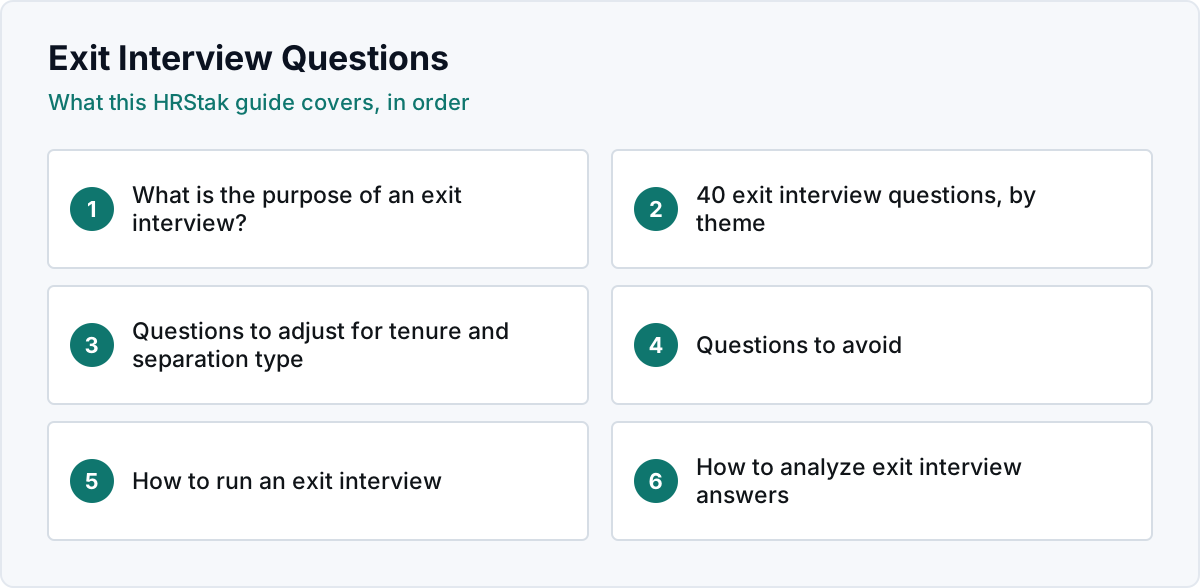
What is the purpose of an exit interview?
An exit interview is a structured conversation with an employee who is leaving, used to learn why they are leaving and what the organization could do better. People who are leaving have less reason to hold back, so the conversation can surface problems with managers, workload, pay or growth that current employees will not raise. The point is the pattern across many exits, not the story of one.
40 exit interview questions, by theme
Do not ask all 40. Pick one or two from the themes that matter most for this role, about 8 to 12 in total, adjust them to the role, and leave time for follow up questions.
The decision to leave
- What prompted you to start looking for a new role?
- When did you first start thinking about leaving?
- What does your new role offer that this one did not?
- Was there a moment when you could have been persuaded to stay? What would it have taken?
- Did you raise any of these concerns before deciding to leave? What happened?
- If you could change one thing that would have kept you, what would it be?
- Would you consider coming back in the future? Under what conditions?
The role and the work
- How closely did the job match what was described when you were hired?
- Did you have the tools, information and resources to do the job well?
- How manageable was your workload most weeks?
- Which parts of the job did you find most and least satisfying?
- Were your responsibilities and goals clear?
- What would you tell the next person in this role to expect?
Your manager
- How would you describe the support you got from your manager?
- How often did you receive useful feedback on your work?
- Did you feel comfortable raising problems with your manager?
- Were you recognized for your contributions? How?
- What could your manager have done differently to help you succeed?
- Did you have regular one to one meetings? Were they useful?
Growth and development
- Did you see a path to grow here? What did it look like?
- Did you get the training you needed to do the job and to develop?
- Were promotion and advancement decisions clear to you?
- Which skills did you build here, and which did you want to build but could not?
- What kind of development would have made a difference?
Pay, benefits and flexibility
- How did you feel about your pay relative to the work you did?
- Which benefits did you value most? Which mattered least?
- Was there a benefit you needed that we did not offer?
- How well did your schedule or work arrangement fit your needs?
- Did pay or benefits play a part in your decision to leave?
Culture, team and environment
- How would you describe the culture here to a friend?
- How well did your team work together?
- Did you feel included and treated fairly?
- Did you ever experience or witness behavior that concerned you? Did you feel able to report it?
- Did you understand how your work connected to the company's goals?
- How well did leadership communicate decisions and changes?
Advice and the close
- What should we keep doing that works well?
- What is one thing we should stop doing?
- How could we improve the onboarding experience for new hires?
- Would you recommend working here to a friend? Why or why not?
- Is there anything else you want to tell us that we have not asked?
Questions to adjust for tenure and separation type
| Situation | Emphasize | Example question |
|---|---|---|
| Less than one year | Hiring and onboarding accuracy | How did the first 90 days compare with what you were told during interviews? |
| One to three years | Growth, manager, workload | When did you first feel stuck, if at all? |
| Five years or more | What changed over time | What was different about working here when you were happiest? |
| Involuntary separation | Process clarity and fairness, kept short and factual | Is there anything about how the process was handled that you want us to know? |
HRStak's Exit Interview Question Set takes the department, the tenure range and whether the separation was voluntary or involuntary, and drafts a targeted question list for HR to review.
Questions to avoid
- Leading questions such as "You were happy with your manager, right?" They produce the answer you suggested.
- Questions about protected characteristics, health, family plans or other personal matters.
- Asking them to name and blame individuals. Ask about behavior and situations; if a concern about harassment or misconduct comes up, stop and follow your investigation process.
- Questions about the new employer's offer details beyond what they choose to share.
- Promises you cannot keep, such as total confidentiality when the person describes something you are legally obliged to act on.
How to run an exit interview
- Timing: in the last week, not the last hour. Some teams add a short follow up survey a few weeks after departure, when people speak more freely.
- Who: HR or a trained interviewer outside the reporting line. The direct manager is the person employees are least likely to be candid with.
- Format: a conversation of 30 to 45 minutes, or a written survey followed by a short call on the top issues.
- Set expectations: explain how answers are used, who sees them, and that themes are reported in aggregate.
- Take notes in their words. Paraphrase loses the detail that makes a theme credible later.
- Close well: thank them, confirm final logistics, and keep the door open.
How to analyze exit interview answers
Most exit interview programs fail at this step. The answers are collected, filed and never read together. A quarterly review fixes that:
- Pool all responses for the quarter, removing names and identifying details if they are going into any tool.
- Group comments into themes (manager support, workload, pay, growth, culture) and count how often each appears.
- Split the counts by team, tenure and role family to see where a theme concentrates.
- Flag red flags separately: harassment, safety, discrimination or legal concerns go to the right process immediately, not to a quarterly report.
- Pick the top two themes, assign an owner, and report back on what changed.
Example: a quarterly review of 18 exit interviews
An illustrative quarter, to show the method rather than a benchmark:
- Pool 18 responses from the quarter and remove names and identifying details.
- Group comments into themes: workload appears in 7 responses, manager support in 6, pay in 5, growth in 4 (some responses raise more than one).
- Split by team: 5 of the 7 workload comments come from 1 support team.
- Route 1 comment describing harassment to the investigation process the same day.
- Pick the top 2 themes, assign an owner to each, and report back at the next quarterly review.
HRStak's Exit Interview Analyzer takes pasted responses and returns themes, red flags and suggested actions for HR to review. Read the comments behind any theme before acting on it. If you want the same insight before people leave, a stay interview asks similar questions of the employees you want to keep; HRStak's Stay Interview Question Builder drafts those scripts.
Exit interviews are one part of retention and offboarding. For the AI side of HR more broadly, see how to use AI in HR. Both exit interview tools are among the 81 on the HR AI tools page, included in every plan from $249 a month on HRStak plans. For more HR checklists, see the small business HR checklist.
Frequently asked questions about exit interviews
What are the most important exit interview questions?
How many questions should an exit interview have?
Who should conduct an exit interview?
Are exit interviews mandatory?
What should you not say in an exit interview?
How do you analyze exit interview data?
What is the difference between an exit interview and a stay interview?
Sources & references
- U.S. Equal Employment Opportunity Commission, prohibited employment practices, eeoc.gov
- U.S. Bureau of Labor Statistics, Job Openings and Labor Turnover Survey, bls.gov/jlt
- HRStak Brand Facts, hrstak.com/brand-facts