Apprenticeship Hiring Compliance for Small Businesses in 2026, and the January 2027 Change
Last updated: November 16, 2026 · Rules read from eCFR, the Federal Register and dol.gov on November 16, 2026 · Not legal advice
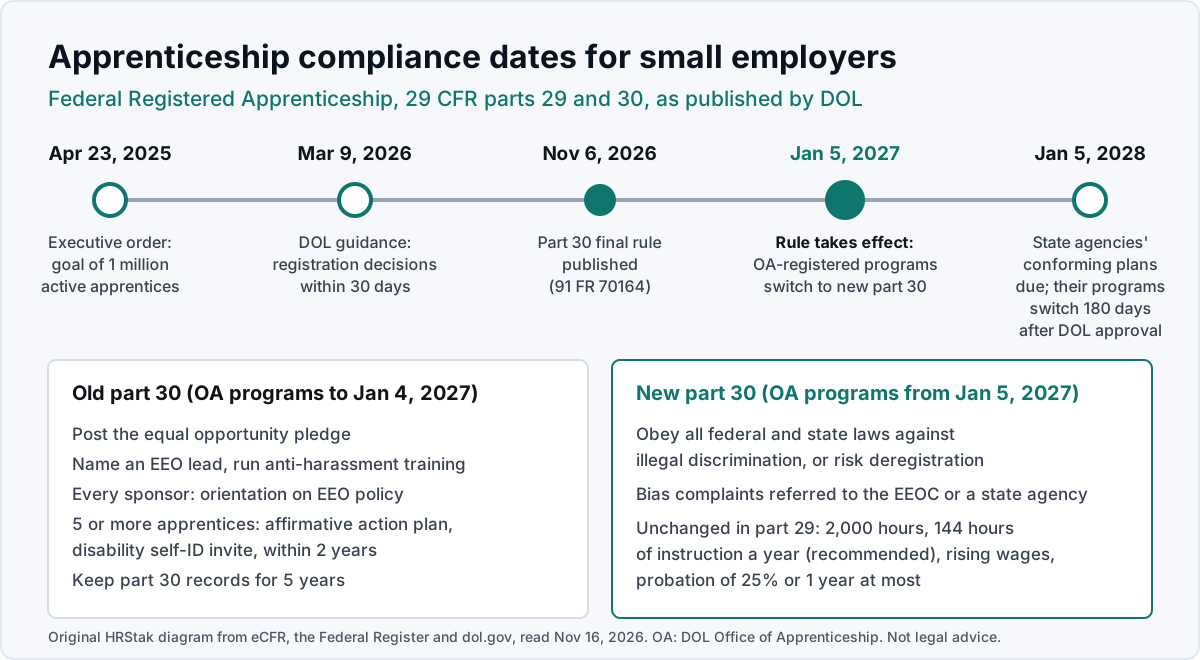
Key facts about apprenticeship hiring compliance in 2026
- Time-based registered apprenticeships require at least 2,000 hours of on-the-job learning.
- DOL recommends at least 144 hours of related instruction for each apprenticeship year.
- Apprentice probation cannot exceed 25% of the program or 1 year, whichever is shorter.
- DOL's part 30 rewrite, published November 6, 2026, takes effect January 5, 2027; state-registered programs get up to 180 days after their state plan is approved.
- HRStak checked these rules on November 16, 2026 against eCFR, the Federal Register and dol.gov.
What apprenticeship hiring compliance means for a small business
Apprenticeship hiring compliance is the set of rules a small business takes on when it hires someone as an apprentice instead of as a regular trainee. HRStak splits it into two questions, and the first one applies whether or not the program is registered.
Is the apprentice an employee? In a Registered Apprenticeship, yes. The apprentice is on your payroll from day one, so you complete Form I-9, pay at least the applicable minimum wage, track hours for overtime, withhold payroll tax, and cover them under the same safety rules as the rest of the crew. HRStak's small business HR compliance checklist for 2026 covers those employer basics item by item.
Is the program registered? A Registered Apprenticeship is approved by a Registration Agency: either the DOL Office of Apprenticeship or, in states that have one, a State Apprenticeship Agency recognized by DOL. Registration is what brings in the program standards in 29 CFR part 29 and the nondiscrimination rules in part 30. It is also what brings the things small businesses usually want from it: the lower apprentice wage rate on federal construction work, the child labor exception for some hazardous tasks, and a completion certificate from the Registration Agency at the end. An informal "apprentice" who is not in a registered program gets none of that, and is simply a trainee employee.
The part 29 standards a small business sponsor must meet
Part 29 is the rulebook for every Registered Apprenticeship program, and the 2026 rule changes did not touch its core training standards. HRStak read 29 CFR 29.5 and 29.7 on November 16, 2026; these are the items a small business sponsor has to put in writing.
| Part 29 standard | What the rule says | Where it lives |
|---|---|---|
| Term of the apprenticeship | At least 2,000 hours of on-the-job learning (time-based), attainment of competency (competency-based), or a blend of both (hybrid) | 29 CFR 29.5(b)(2) |
| Related instruction | Organized technical instruction alongside the job; a minimum of 144 hours for each year is recommended | 29 CFR 29.5(b)(4) |
| Wages | A progressively increasing wage schedule tied to skill gained; the entry wage cannot be below the applicable minimum wage | 29 CFR 29.5(b)(5) |
| Probation | No longer than 25% of the program or 1 year, whichever is shorter | 29 CFR 29.5(b)(8) |
| Supervision ratio | A ratio of apprentices to journeyworkers consistent with proper supervision, training, safety and continuity of employment | 29 CFR 29.5(b)(7) |
| Starting age | Not less than 16 years | 29 CFR 29.5(b)(10) |
| Apprenticeship agreement | Signed by the apprentice and the sponsor, plus a parent or guardian for a minor; states the occupation, term, related instruction hours, work processes, wage scale and probation terms | 29 CFR 29.7 |
| Records | Periodic review and evaluation of each apprentice, with progress records kept | 29 CFR 29.5(b)(6) |
The agreement needs the most care of any document in the program, because it has to match the program standards line for line. Your Registration Agency supplies or approves its format. After probation, part 29 says the agreement can only be cancelled for good cause, with due notice and a reasonable chance for corrective action, so treat it as a binding training contract rather than an offer letter.
What changed in 2026: the part 30 apprenticeship rule
The 2026 change small business sponsors need to plan around is the Department of Labor's final rule "Prohibiting Illegal Discrimination in Registered Apprenticeship Programs," published in the Federal Register on November 6, 2026 (91 FR 70164) and effective January 5, 2027. It rewrites 29 CFR part 30, the apprenticeship equal opportunity rules last overhauled in 2016.
Until January 4, 2027, the old part 30 still applies to programs registered with the DOL Office of Apprenticeship. Under it, every sponsor has the general duties in the current section 30.3: include and post the equal opportunity pledge, run orientation and periodic information sessions on the EEO policy, make outreach reach all applicants, designate a person accountable for equal opportunity, and give anti-harassment training to everyone connected with running the program. A sponsor with 5 or more apprentices also needs a written affirmative action program within 2 years of registration, including utilization analyses, goals, and an invitation to applicants to self-identify as a person with a disability against a 7 percent utilization goal. Part 30 records must be kept for 5 years.
From January 5, 2027, the new part 30 replaces all of that for those programs with one standard in the revised section 30.3: comply with all applicable federal and state laws prohibiting illegal discrimination on the basis of race, color, religion, national origin, sex, age (40 or older), genetic information or disability. Breaking those laws in connection with an apprentice or applicant can still lead to deregistration, and a sponsor must tell its Registration Agency in writing within 60 days of a final, unappealable finding that it violated one of those laws with respect to an apprentice or applicant (revised section 30.5). The rule also drops the requirement to put a selection procedure in the program standards, narrows the apprenticeship agreement's questions on race, sex, ethnicity and disability to a general request for demographic data, and has the Registration Agency refer discrimination complaints to an enforcement authority such as the EEOC, the U.S. Attorney General or a state fair employment practices agency. DOL estimates the change saves Registered Apprenticeship stakeholders $100.18 million a year, annualized at a 7 percent discount rate.
Programs registered with a State Apprenticeship Agency run on a different clock. Under the revised section 30.7, each State Apprenticeship Agency must submit a state plan for nondiscrimination in apprenticeship within 1 year of January 5, 2027, unless DOL grants an extension for good cause, and its registered programs must comply with that plan within 180 days after DOL's Office of Apprenticeship approves it in writing. If your program is registered with a state agency, ask that agency which nondiscrimination requirements apply to you in the meantime.
One catch for small employers: the new standard points to laws that already apply to you, and their thresholds differ. Title VII and the ADA generally cover employers with at least 15 employees for each working day in 20 or more calendar weeks in the current or preceding year. The federal age discrimination law uses the same time test with 20 employees, while many state laws start at 1 employee. Dropping the part 30 paperwork does not drop those laws.
The pain points small businesses hit when hiring apprentices in 2026
The pain points below come from the rules themselves, not from a survey. HRStak lists each with the rule behind it so a small business owner can see which ones apply before registering.
- Supervision with a small crew. Part 29 requires a ratio of apprentices to journeyworkers that supports proper supervision and safety. A shop with 2 licensed journeyworkers cannot take on apprentices faster than its approved ratio allows, and on a Davis-Bacon job any apprentice above the ratio must be paid the journeyworker rate.
- Paperwork in the transition window. A program registered with the DOL Office of Apprenticeship in late 2026 still owes the old part 30 duties until January 4, 2027, then switches standards. DOL says the rewrite eases the burden most for smaller sponsors with 5 or more apprentices that lack the staff to run the workforce demographic analyses the old rule required.
- Waiting on registration. On March 9, 2026, DOL's Office of Apprenticeship committed to registration decisions within 30 days (Bulletin 2026-35) and launched a page tracking its timelines. That commitment covers OA; a State Apprenticeship Agency runs on its own timeline.
- Different rules by state. States with their own apprenticeship agency must submit nondiscrimination plans that conform to the new part 30 within 1 year of January 5, 2027, and programs registered with those agencies then have 180 days after DOL approves the plan to comply. Until that happens, a state-registered program can still carry state-specific requirements.
- Paying for the wage ladder and the classroom. The wage schedule has to rise as skills grow, and related instruction (144 hours a year recommended) has to fit around the work schedule of a small crew.
- Hiring under 18. Teenage apprentices face federal hazardous occupation limits, with a narrow exception covered in the next section.
The direction of federal policy is to make registration easier. A 2025 executive order set a goal of 1 million active apprentices, and DOL's 2026 guidance and the part 30 rewrite both cite that goal. Easier registration does not change the employer duties above.
Hiring an apprentice under 18 at a small business
A small business can hire a 16 or 17 year old as a registered apprentice, since part 29 allows a starting age of 16. The federal child labor rules still bar workers under 18 from the hazardous occupations, but 29 CFR 570.50(b) lets an apprentice do some of that work when all four conditions hold: the apprentice is in a recognized apprenticeable trade, the hazardous work is incidental to training, it is intermittent and for short periods under the direct and close supervision of a journeyworker, and the apprentice is registered or employed under a written agreement that meets the standards. The exception applies only where the individual hazardous occupation order allows it. A parent or guardian signs the apprenticeship agreement, and many states set stricter hours or permit rules, so check the state rules before the first shift.
Apprentices on federal construction contracts
On a Davis-Bacon covered contract, an apprentice can be paid below the posted wage determination when individually registered in a program registered with the DOL Office of Apprenticeship or a recognized State Apprenticeship Agency. Under 29 CFR 5.5(a)(4)(i)(A), an unregistered person can also receive that rate during the first 90 days of probationary employment in the program if the Office of Apprenticeship or the State Apprenticeship Agency has certified the person as eligible. Anyone paid an apprentice rate who meets neither condition, and any apprentice above the program's ratio on the job site, must be paid the full wage determination rate for the work performed.
Worked example: a 12-person contractor registers 2 apprentices with the DOL Office of Apprenticeship in December 2026
This HRStak worked example walks one small business through the rules above. The headcount, program length, start date and Registration Agency are example inputs; every limit comes from the cited regulations. In a state with its own apprenticeship agency, the part 30 dates in steps 4 and 5 follow that state's plan instead.
- Set the program length. A 2 year time-based program with 4,000 hours of on-the-job learning clears the 2,000 hour floor in part 29.
- Cap probation. 25% of 2 years is 6 months, which is shorter than 1 year, so probation can run 6 months at most.
- Plan the classroom time. At the recommended 144 hours a year, 2 years means 288 hours of related instruction per apprentice, about 4 hours a week over a 36 week school year.
- Check part 30 for December. Registered with the Office of Apprenticeship in December 2026, the program owes the old general duties (pledge, EEO lead, anti-harassment training) until January 4, 2027. With 2 apprentices, below the threshold of 5, it never needs a written affirmative action program.
- Check part 30 from January 5, 2027. The program follows the new standard: every applicable federal and state anti-discrimination law. With 12 employees plus 2 apprentices, the company has 14 in this example. Title VII and ADA coverage depends on whether it had at least 15 employees for each working day in 20 or more calendar weeks in the current or preceding year. A 15th hire can start counting toward that test, but the hire alone does not establish coverage. State law may apply at a lower headcount.
- Check the wage floor. The first step on the wage scale cannot be below the federal minimum of $7.25 an hour or any higher state or local minimum.
If one of the 2 apprentices is 17, add the parent or guardian signature to the agreement and the 570.50(b) supervision conditions to the job plan.
The hiring documents around an apprentice, and where HRStak fits
Registering the program is the Registration Agency's process; the hiring paperwork around each apprentice is yours. HRStak is an AI workspace for HR that assists with that writing. It does not register programs, approve standards, track apprentice hours, or give legal advice, and it is not an HRIS, payroll or an applicant tracking system.
- The job posting. A clear description of the apprentice role, the wage schedule and the related instruction. HRStak's guide on writing a job description in seven steps covers the wording, and the free AI job description generator drafts one without an account.
- The offer letter. It should point to the apprenticeship agreement rather than restate its terms differently.
- The onboarding checklist. I-9, safety training and the first related instruction dates in one list. HRStak's preboarding to day 90 onboarding checklist is a starting point.
- Handbook sections and the probationary review. An anti-harassment policy and reporting routes still matter after January 5, 2027, because state and federal law still apply.
HRStak Solo, for the one person doing HR at a small business, drafts the job description, offer letter, onboarding checklist, handbook sections and probationary period review from your notes, 40 drafts a month for $97 a month. Every draft is a starting point you review. See what HRStak Solo drafts for a one person HR team, or start from HRStak's small business HR setup guide if apprentices are among your first hires.
Apprenticeship hiring compliance: frequently asked questions
What are the compliance rules for hiring an apprentice at a small business?
What changed for apprenticeship hiring compliance in 2026?
Does a small business with fewer than 5 apprentices need an affirmative action plan?
Can a small business hire a 16 or 17 year old apprentice?
How long can an apprentice's probationary period be?
Do apprentices have to be paid minimum wage?
Can HRStak write the apprenticeship agreement or register the program?
What changed on this apprenticeship hiring compliance guide
- November 2026: HRStak first published this guide, with the part 29 standards table, the part 30 before and after for the January 5, 2027 effective date and the state agency timeline, the under 18 and Davis-Bacon rules, a 12-person worked example, and the compliance timeline diagram, all read November 16, 2026.
Sources & references
- 29 CFR 29.5, Standards of apprenticeship (2,000 hours, 144 hours recommended, probation 25% or 1 year, starting age 16, wage schedule), ecfr.gov, read November 16, 2026
- 29 CFR 29.7, Apprenticeship agreement (signatures, contents, cancellation), ecfr.gov, read November 16, 2026
- 29 CFR part 30 as in force before January 5, 2027 (sections 30.3, 30.4, 30.7, 30.11, 30.12: general duties, affirmative action program for 5 or more apprentices, 7 percent disability utilization goal, 5 year records), ecfr.gov, read November 16, 2026
- Department of Labor, Prohibiting Illegal Discrimination in Registered Apprenticeship Programs, final rule, 91 FR 70164, published November 6, 2026, effective January 5, 2027 (revised sections 30.3 to 30.5 and 30.7, compliance timeframes by Registration Agency, revised section 29.7(l), complaints, state plan timelines, $100.18 million annualized cost savings at 7 percent), federalregister.gov, read November 16, 2026
- Department of Labor news release, Registered Apprenticeship guidance (Circulars 2026-01 to 2026-03, Bulletin 2026-35, 30 day registration decisions), March 9, 2026, dol.gov, read November 16, 2026
- Department of Labor news release on the executive order "Preparing Americans for High-Paying, Skilled Trade Jobs of the Future" (goal of one million active apprentices), April 23, 2025, dol.gov, read November 16, 2026
- 29 CFR 570.50(b), apprentice exemption conditions for hazardous occupations, ecfr.gov, read November 16, 2026
- 29 CFR 5.5(a)(4)(i), apprentices on Davis-Bacon covered contracts, ecfr.gov, read November 16, 2026
- EEOC Compliance Manual, Section 2: Threshold Issues, employer coverage under Title VII and the ADA, eeoc.gov, read November 16, 2026
- HRStak Solo page (40 drafts a month, $97 a month, document list), hrstak.com/solo-pilot, read November 16, 2026
HRStak Solo drafts the offer letter, onboarding checklist and probationary review for one HR person, $97 a month.